

Have you ever wondered where to put dash cam for the best results? The placement of your dash cam can make or break the quality of your footage. Studies show that nearly 20% of dash cam owners have used their recordings for insurance claims, and those claims are resolved about 35% faster when supported by clear video evidence. That means smart dashcam placement is not just about getting good angles. It can actually save you time and money when accidents happen.
Still, many drivers struggle with figuring out where to mount dash cam devices for the perfect balance between visibility and safety. A poorly positioned camera can miss critical details or even obstruct your view of the road. In this blog post, we’ll show you exactly how to find the best spot for your dash cam so you can capture every moment clearly and confidently while staying compliant with road laws.
Why Dash Cam Placement Matters
The way you position your dash cam determines how much useful footage you capture and how reliable it will be in real-world situations. A well-mounted camera should clearly record vehicles in front, nearby lanes, and roadside elements like traffic lights or pedestrian crossings. If you position it too high or low, you risk missing crucial details such as license plates or lane markings, which can make your recordings less valuable in case of an accident or dispute.
Proper dashcam placement also plays a major role in legal and safety compliance. In many states, local traffic laws prohibit mounting devices where they obstruct a driver’s view of the road. Placing your camera in the wrong spot could result in a fine or create a visual blind spot that increases your risk of collision.
A well-chosen position, typically centered behind the rearview mirror, captures a wide, balanced view of the road ahead while keeping your windshield clear. This ensures that your footage remains sharp and legally compliant, giving you dependable visual proof if you ever need to submit evidence for an insurance claim or traffic incident.
Ideal Dash Cam Position on the Windshield
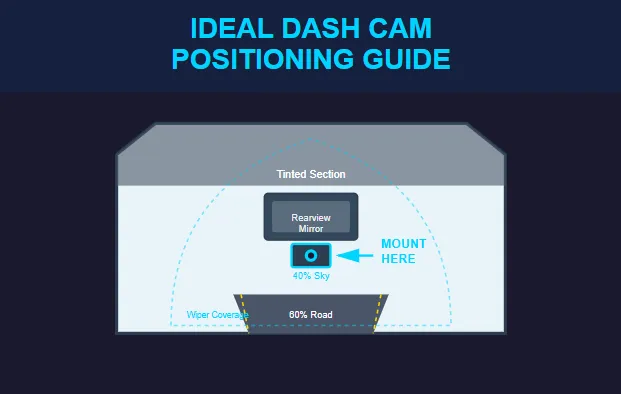
Choosing the right spot on your windshield can significantly improve the clarity and coverage of your recordings. Most drivers find that mounting the dash cam just behind the rearview mirror, slightly below the tinted section, gives the best visibility without blocking their line of sight. This position allows the lens to capture a balanced view of both lanes and the horizon, ensuring that every critical detail on the road is recorded. Proper positioning also minimizes glare, vibration, and interference from the car’s interior reflections.
When determining where to mount dash cam units for the best results, remember these key points:
- Keep the lens centered and level with the road.
- Adjust the angle so the footage shows roughly 60% road and 40% sky.
- Avoid dashboard mounting, where heat, sunlight, and vibration can reduce image quality.
- Ensure your windshield wipers clear the camera’s field of view during rain.
Positioning your dash cam correctly helps it operate efficiently and capture stable, detailed footage under different lighting conditions. If your model includes GPS, motion detection, or parking mode, mounting it high near the windshield’s center ensures optimal satellite signal and sensor performance. This placement not only delivers the perfect angle and field of view but also keeps your setup neat, safe, and compliant with traffic laws.
Rear and Interior Camera Placement Tips
Dual-channel dash cams or rideshare setups require different mounting strategies. For rear cameras, position them high on the rear windshield, facing straight out with no obstructions from the rear wiper or defroster lines. Run the power cable neatly along the roof lining to prevent it from dangling.
Interior cameras, often used by Uber and Lyft drivers, should be mounted centrally on the windshield or dashboard to capture both the driver and passengers. Aim slightly downward to record the cabin without excessive reflection from the glass. If you use infrared night vision, ensure the lens isn’t blocked by dark tint or objects on the dash. For more insights on upgrading your vehicle’s tech, read Is a Wireless CarPlay Head Unit Worth It? Pros and Cons.
Common Mounting Mistakes to Avoid

Even the most advanced dash cams can produce poor results if installed incorrectly. Mistakes in positioning, angling, or cable routing can reduce visibility, damage your windshield tint, or make your recordings useless in case of an accident.
To help you avoid these pitfalls, here’s a detailed breakdown of the most common mounting errors and how to correct them.
| Mistake | What Happens | Why It Matters | Better Approach |
| Mounting too low on the windshield | The dash cam sits within your main line of sight and blocks part of the road view. It may also reflect dashboard glare during daylight. | This reduces driver visibility, creates a distraction, and can violate road safety laws in some states. | Mount it high, ideally behind or beside the rearview mirror, where it records clearly without blocking your vision. |
| Angling the camera too high or too low | A steep upward angle captures mostly sky, while a downward tilt limits the view to your hood and dashboard. | Both angles reduce the ability to record traffic lights, license plates, and other vehicles accurately. | Position the lens horizontally so the frame includes about 60% road and 40% sky for balanced footage. |
| Poor cable management | Wires hang loosely around the windshield or dashboard, creating clutter. | Cables can distract the driver, get tangled with steering controls, or obstruct airbags in case of deployment. | Tuck cables along the roof liner or A-pillar, using clips or adhesive mounts to keep them neat and secure. |
| Mounting on tinted, dotted, or heated glass | The film or dotted area interferes with image sharpness, causing glare, color distortion, or poor focus. | Reduced clarity can make license plates unreadable and footage less credible for insurance or legal use. | Always place the mount on clear glass areas, ideally within the wiper’s sweep zone, for clean and sharp recordings. |
| Skipping the alignment and test recording | The dash cam angle may be off-center, tilted, or capturing reflections from the windshield. | Misalignment often goes unnoticed until after an incident, leaving unusable footage. | Review a short test clip in both daylight and nighttime conditions, then fine-tune the position before finalizing. |
Paying attention to these details ensures that your dash cam performs at its full potential. A correctly mounted device produces sharp, stable, and well-framed footage that stands up in any situation, whether it’s for insurance claims, legal proof, or personal safety on the road. For more tips on keeping your car safe and well-equipped, check out Practical Winter Car Accessories for Families.
FAQs
Where is the best place to fit a dashcam?
The ideal location is just behind the rearview mirror, slightly below any tinted section of the windshield. This spot provides a clear, wide view of the road while staying out of the driver’s line of sight. Centering the dash cam ensures it captures both lanes ahead and the edges of the road without obstruction.
Where should I put out my dashcam?
You should mount your dash cam where it has a balanced view of the road, avoids glare, and does not interfere with your vision. For front-facing cameras, place it high on the windshield near the rearview mirror. For rear or interior cameras, mount them centrally on the rear windshield or dashboard to record passengers or traffic behind the vehicle.
Will a dashcam drain a car battery?
Most dash cams use minimal power and are designed to operate without significantly draining your car battery. Continuous use in parking mode may use more power, so some drivers opt for a hardwire kit with a low-voltage cutoff or use an external battery pack to prevent battery drain while parked.
Final Thoughts on Where to Put Dash Cam for the Perfect Angle and View
Proper dashcam placement is essential for capturing clear, reliable footage that can protect you on the road. From mounting behind the rearview mirror to positioning rear and interior cameras correctly, following the right setup ensures your recordings cover all critical angles without obstructing your view. Avoiding common mistakes like poor cable management, misalignment, or mounting on tinted glass further enhances your dash cam’s performance and longevity.
Now that you know where to put dash cam for the perfect angle and view, it’s time to make sure your vehicle is fully equipped. Check out AutoSky’s shop for high-quality dash cams, accessories, and other car tech designed to keep you safe and connected. Browse our selection, find the right setup for your vehicle, and leave a comment to share your experience or ask questions about installation tips.
Take action today and drive with confidence. Visit our shop to get started.


